Immigration (Enhanced Risk Management) Amendment Bill

The Government has announced proposed changes to the Immigration Act which will affect residence visa holders and temporary visa holders. These changes are currently progressing through Parliament with select committee submissions close date on 29 April 2026. We are summarised some of the changes that will impact resident visa holders and temporary visa holders.
Deportation Settings
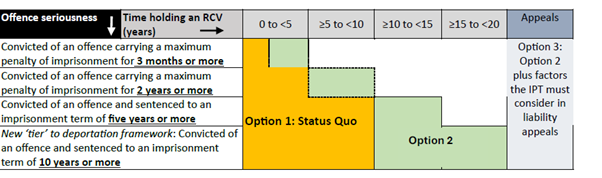
A key feature of the Bill is the increasing of period that convictions can trigger deportation liability for residence class visa holders.
For lower-level offending, the deportation liability period will increase from 2 years to 5 years. For more serious offending, the liability period will extend from 10 years to 20 years. A snippet of the proposed changes is at the end of the article.
Additionally, victims of serious offences committed by migrants will have the right to be heard during deportation proceedings, regardless of whether the victim was directly associated with the offending for which the deportation liability is raised.
Appeal Rights and Deportation Proceedings
The Bill also proposes changes to appeal rights for visitor visa holders and temporary visa holders who have committed criminal offences.
Under the proposed changes, these visitor holders and people who had held a visitor visa prior to becoming unlawful will no longer be able to appeal their deportation liability to the Immigration and Protection Tribunal on humanitarian grounds.
Temporary visa holders with convictions will lose the ability to appeal to the IPT on humanitarian grounds. After the changes come into effect: doctors, nurses, engineers and other skilled workers that receive a conviction e.g. for drunk driving will be at risk of deportation without the ability to appeal to the IPT on humanitarian grounds (putting their ability to remain in New Zealand at serious risk).
Migrant Exploitation
The Bill the maximum penalty for exploitation offences from seven years’ imprisonment to ten years.
In addition, new infringement offences will be introduced for providing false or misleading information, or for withholding relevant information. The timeframe for authorities to detect and respond to migrant exploitation offending will also be extended — from 90 days after the offending occurred to 270 days from the date the Ministry of Business, Innovation and Employment (MBIE) becomes aware of the offending.
Changes Affecting Asylum Seekers
The Bill proposes preventing individuals from applying for a further visa while remaining in New Zealand after withdrawing an asylum claim. This change is intended to discourage abuse of the asylum system by individuals who lodge claims to remain in New Zealand while seeking alternative immigration pathways.
Moving Forward
New Zealand’s immigration framework continues to evolve, and further changes are expected throughout 2026. Our team of specialists is available to provide tailored, practical advice to help individuals and employers navigate the increasingly complex and shifting immigration landscape.
Please do not hesitate to contact us if you require assistance.
Disclaimer: We remind you that while this article provides commentary on employment law, health and safety and immigration topics, it should not be used as a substitute for legal or professional advice for specific situations. Please seek legal advice from your lawyer for any questions specific to your workplace.